

Teaching
After decades dedicated to the profession, and with such a peculiar minimally invasive hip surgery, I have begun, several years ago, a path of teaching to young surgeons and to all those who want to approach this type of surgery.
I will give you an example: in the USA, in 2015, about 16% of surgeons performed direct anterior approach; in 2024 there was a reversal, therefore more than 50%, precisely 56% of surgeons perform anterior access in direct anterior approach hip replacement surgery.
This direct approach access has been demonized a lot in the past, calling it a fad, a surgical route that required a long learning curve and, last but not least, the scientific literature that reported complications that were clearly higher than traditional access routes. This was due, and I was the main actor, to the lack of learning and teaching by surgeons who were experts in this discipline. There were few of them, in disparate centers, both in Europe and in the United States.
Until a few years ago, dedicated cadaver labs were not even carried out and there was a lot of approximation and improvisation, leading to very poor results.
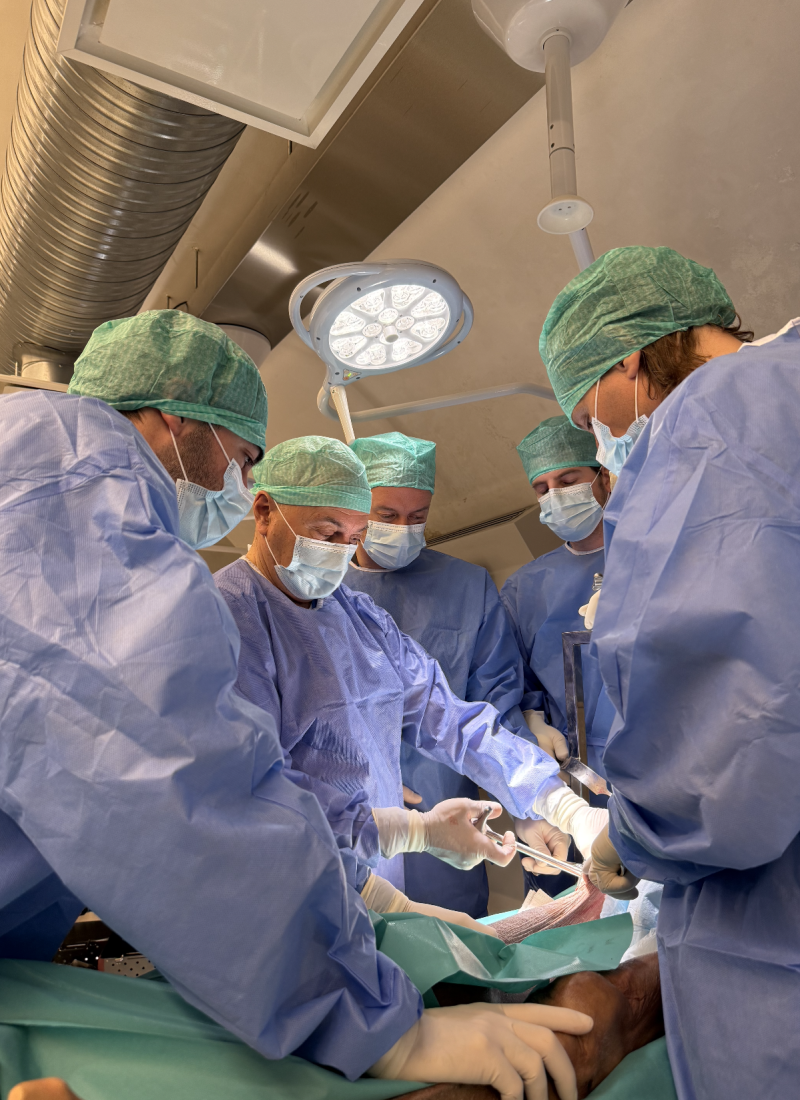
Currently, in Italy, about 18% of surgeons, with a percentage that is constantly increasing, perform the direct anterior approach to the hip as the main surgical technique. This is why I have been performing cadaver-lab for several years and I host in my operating rooms an ever-increasing number of young and older surgeons, who are starting to approach this procedure or to improve their aptitude for this access route.
There are now dedicated instruments that greatly facilitate the surgical act, although in truth many companies, even well-known ones, do not yet have a focus on this method. The new interest by many surgeons is leading to a refinement of this technique and this is reflected in international literature with positive results for this access route.
This technique is particularly indicated in complex cases, such as atypical bone anatomies or revisions of previous prostheses, where the precision of robotics offers a significant advantage.
Thanks to 3D pre-operative planning and visualization
in real time, optimal positioning of the prosthesis can be ensured, reducing the risk of complications and improving the longevity of the implant.
Faster recovery and greater patient satisfaction, these are the results.